

The Wildlife & Integrated Livelihood Development (SAT-WILD) program is a long-term project developed by Sustainable Agriculture Technology (www.sat-zim.org)

Our Work
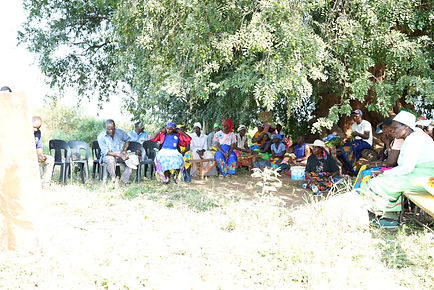
We work with rural communities, District Authorities, Zim-Parks & other partners to co-create holistic win-win outcomes for people & conservation in the Zimbabwean portion of the Great Limpopo Trans-frontier Conservation Area (GLTFCA).
- Diversifying livelihoods; boosting food security; restoring & protecting the environment; promoting equitable representation and good governance; enhancing education; developing nature-positive enterprise & eco-tourism partnerships; maintaining ecosystem balance; and building coalitions for positive socio-economic and environmental change in the landscape.
Sengwe Tshipise Coalition
Our Mission and Vision
The Sengwe Tshipise Corridor (STC), comprising +/- 400km2 strip of community-owned land in Zimbabwe, is legally designated to form a physical wildlife & tourism corridor between Gonarezhou National Park in Zimbabwe and Kruger National Park (KNP) in South Africa, with a partial link to Limpopo National Park in Mozambique.
As such, the area forms a critical geographic link between the Zimbabwean and South African components of the GLTFCA to enable free movement of wildlife between these large protected areas, and, in the process unlock potential ecotourism - as a catalyst for integrated green economic development for local communities.
After 15+ years of working in the landscape , SAT-WILD has partnered with Chiredzi RDC, Zim-Parks, FZS, GCT, local communities, and other stakeholders to support holistic integrated development of the Sengwe Tshipise Wilderness Corridor and to unlock its potential to drive positive socio-economic & environmental change for the benefit of people & nature.
This ambitious initiative - one of the most exciting community conservation projects in Africa - requires comprehensive stakeholder engagement and a multi-faceted approach to meeting the needs of people, while creating opportunities for restoration and protection of the environment.
As elaborated in subsequent sections, we focus on several thematic areas:
-
Community rights, gender / youth equity, benefits, & representation
-
Enhanced food security & livelihood diversification
-
Environmental restoration and protection
-
Ecotourism & nature-positive green economic development
-
Mitigation of Human-Wildlife-Conflict
-
Enhancing education & social services
-
Promoting local tradition & culture
Our approach can be summed up as:
-
Open dialogue
-
Form partnerships
-
Identify challenges
-
Solve for people
-
Solve for nature
-
Keep collaborating
READ MORE ABOUT OUR INTERVENTIONS BELOW


Challenge 1: Severe chronic food insecurity
-
Crop-failure has become the norm in the extremely hot, dry, drought prone SE Lowveld of Zimbabwe
-
This barren wasteland has become all too common-place with complete or near-complete crop failure in 9 of every 10 years!
-
Worse-still, shifting dry-land agriculture has driven severe environmental devastation - and local communities are peering over the precipice of complete ecological collapse
-
WILD-Dev treats food insecurity as an acute socio-ecological priority: it is only through addressing this most basic human need that communities can thrive and the land can heal

01
Syntropic Agroforestry
In partnership with local communities, and with funding support from the European Union, the Light Foundation, Oak Foundation, and Coca-Cola, SAT-WILD has developed innovative syntropic agroforestry models that are a game-changer for food security, climate adaptation, and nutritional diversification at household level - all while restoring soils and the environment.
Integrating dozens of species of indigenous trees, intermingled with fruit-trees, staple crops, and a wide array of veggies, the intensified production - making use of much smaller units of land - facilitates restoration of hundreds of hectares of degraded agricultural land - focusing on rangelands, water catchments, riparian woodlands, floodplains, wetlands, and rivers.
02
Malipati Agri-Hub
SAT-WILD partnered the Government of Zimbabwe - Chiredzi RDC, and the Malipati community to develop the Malipati Agri-Hub as an innovative social enterprise for intensified climate-adapted agricultural production at scale to produce high volumes of staple crops for value-addition and processing to highly nutritious pre-cooked meal - for local schools and vulnerable households.
The initiative was established with generous support of the European Union, Light Foundation, and Oak Foundation. Revenues generated are ploughed back into environmental restoration, schools renovation, local employment, and diversified nature-positive microenterprise.


03
Aquaponics
With support of the Light Foundation, SAT-WILD developed aquaponics units - integrating the production of fish, veggies, rabbits, and poultry - at Salani Village and Chingele Orphanage.
Employing the ecological integration and nutrient flows found in natural systems - the highly productive units are extremely water efficient (<200l/week), require remarkably little labour, and produce a broad array of highly nutritious produce for orphans and local households

Challenge 2: Severe environmental degradation
-
Decades of unplanned shifting agriculture, overharvesting of fuel-wood, and overstocking with livestock - compounded by recurrent drought and climate change - have resulted in severe degradation of the environment, catastrophic deforestation, widespread loss of topsoil and fertility, loss of soil moisture, depletion of ground water, and siltation of rivers and wetlands.
-
WILD-Dev sees restoration of functional ecosystems and the vital ecosystem-services they provide as being critically important for long-term survival of humans and nature
01

Restoration & Protection of Manjinji Pan
In 2019, and with generous support of the European Union, SAT-WILD partnered with the Malipati Community Development Trust, Gonarezhou Conservation Trust, and Chiredzi RDC to restore and protect the Manjinji Pan Wetland and Bird Sanctuary - which is a critically important wetland for recharge of the water-table feeding the local irrigation scheme. The pan has a huge diversity of trees and birds and is a major breeding site for migratory waterfowl.
In addition to development of fencing, scout bases, community centre and introduction of active protection, we developed a number of exclusive serviced camping sites to generate income and employment for the local community.
Campsites can be booked through www.gonarezhou.org
02
Environmental Restoration
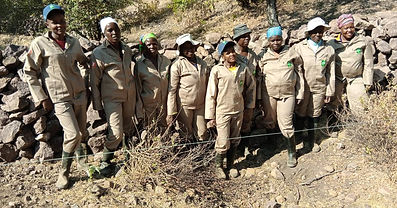
Since 2024 the WILD program has employed teams of local ladies for active reafforestation and restoration of the environment.
In addition to setting aside land for natural revegetation, the restoration teams have planted thousands of indigenous trees and built hundreds of "leaky weir" rock dams to restore eroded drainage gullies and streams.
This highly successful program has trapped thousands of tons of invaluable topsoil and rain-water that previously would have rushed through deeply eroded gullies in a matter of minutes, is now retained for days and even weeks on end so rehydrating the land and recharging the local water-table - which is of vital importance to climate resilience and survival of local communities in this hot, arid landscape.
The program continues to expand and to employ larger groups of women supported by revenue generated through the Malipati Agri-Hub and other social enterprises established and managed by WILD-Dev and our partners.

03

Environmental awareness & reafforestation
SAT-WILD works with local authorities, Environment Management Agency, Forestry Commission, local schools and other partners in running extensive environmental awareness and re-afforestation programs in local communities.
Having established community-owned tree nurseries to support roll-out of agroforestry and restoration activities, we distribute a wide array of non-invasive trees (mainly indigenous, but also fruit trees and other trees of use to local households) - for replanting at environmental awareness training events.
Together with our community partners, SAT-WILD is supporting restoration of the riparian woodland, tributaries, and floodplains along 30+km of the Mwenezi River - to restore river health and water security in this hot, arid landscape.